
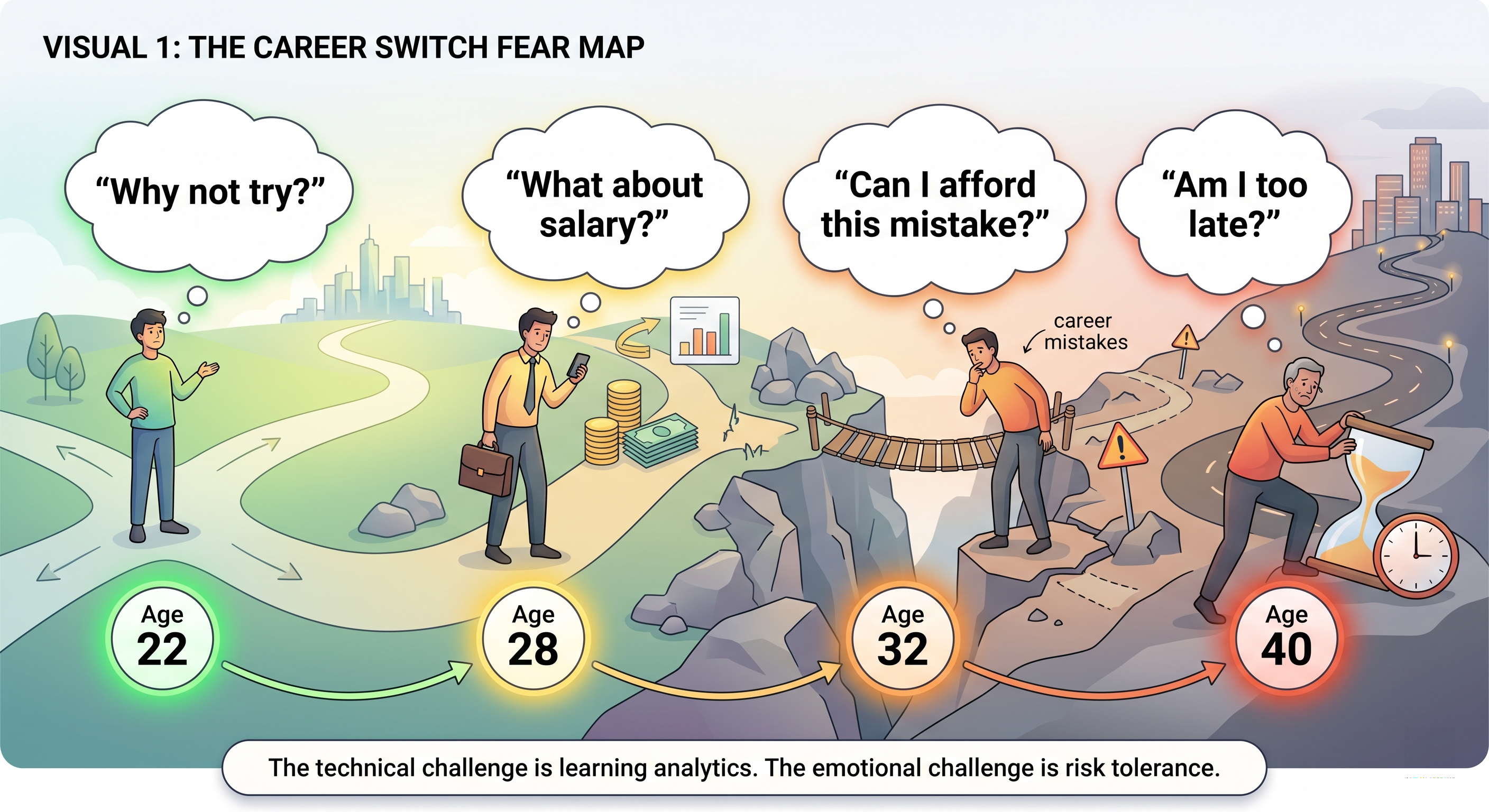
At 22, switching careers feels exciting. At 28, it feels risky. At 32, it feels irresponsible. At 40, it feels almost absurd.
That’s the emotional story many people tell themselves. Not because they lack ambition. Because adult life changes the math.
At 22, experimentation is cheap. At 32, you may have:
- Rent
- EMIs
- Family expectations
- A partner depending on stability
- Responsibilities that don’t care about your career reinvention arc
So when people think about an analytics career switch, the actual fear is rarely: "Can I learn SQL?"
The real fear is: "What if I leave something familiar and fail?"
That’s a much heavier question. And it deserves an honest answer. Because yes, many people successfully break into analytics in their late 20s, 30s, even beyond. But not everyone should. And pretending otherwise helps nobody.
First: No, You Are Not “Too Old”
Let’s kill that idea immediately. Companies do not reject someone from a data analyst career path because they turned 31, 35, or 40. Age itself is rarely the issue. Perceived risk is.
Employers ask:
- Can this person learn quickly?
- Can they solve problems?
- Do they communicate well?
- Will they adapt?
- Does their profile make sense?
That’s very different from age discrimination narratives people tell themselves.
The harder truth? Being older can actually help—if your previous experience transfers. A former operations manager understands processes. A marketer understands customer funnels. A finance professional understands business metrics. A salesperson understands conversion behavior.
Analytics is not just tools. It’s business reasoning with data. That means experience can be an advantage.
But Let’s Be Honest About the Salary Fear
This is the real issue. Not age. Money. Someone searching how to become a data analyst in India at 30 is not asking the same question as a 21-year-old fresher.
The fresher asks: "How do I get my first job?" The career switcher asks: "Can I survive the transition?" Different problem.
Because salary resets are real. If you’re earning ₹10–18 LPA in a stable non-analytics role, switching into entry-level analytics may mean stepping backward temporarily. That’s uncomfortable. Sometimes impossible.
This is where bad advice appears: "Just follow your passion." No. That’s reckless. A career switch is a business decision. You need to model downside.
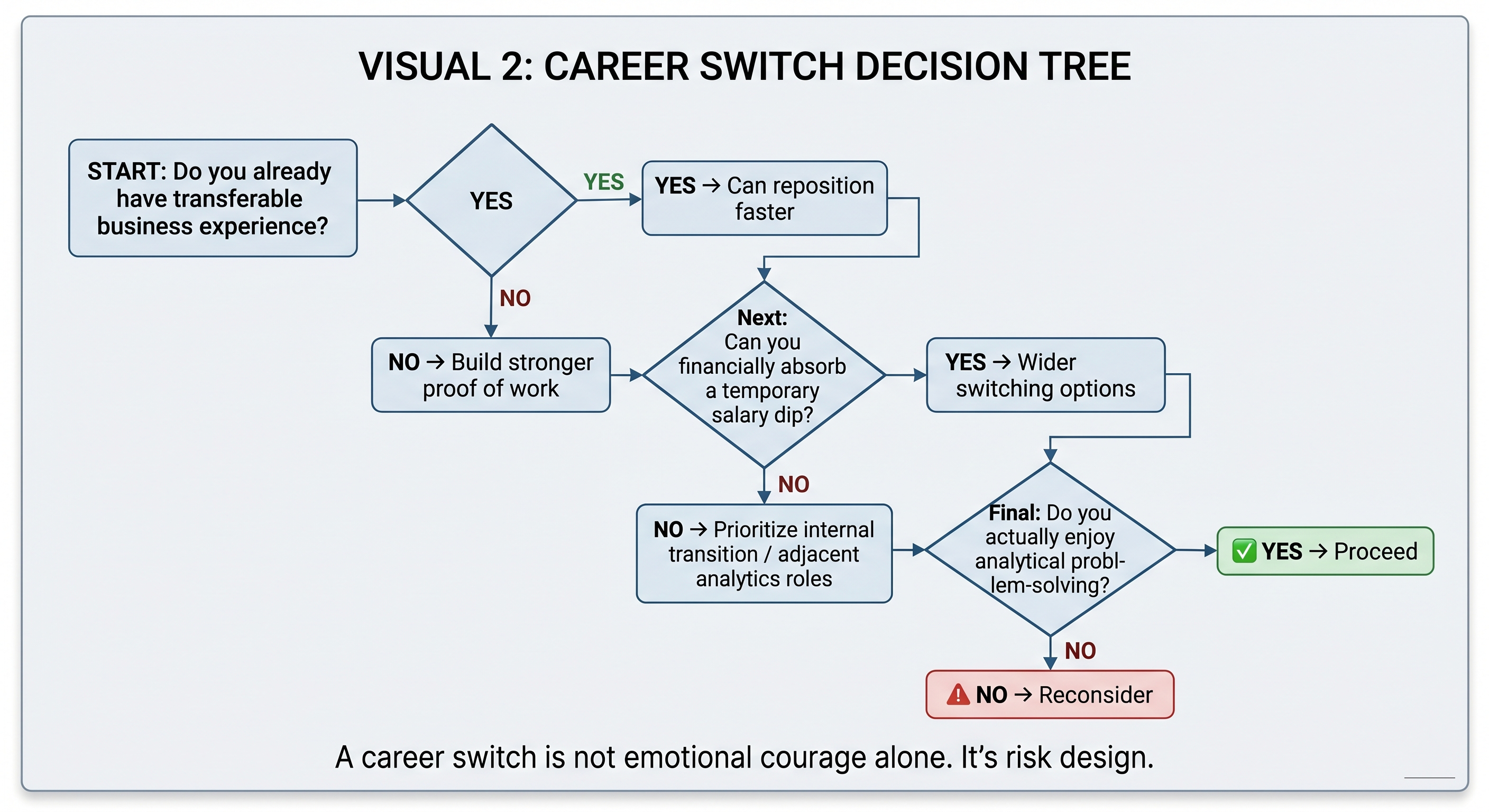
Ask yourself:
- How many months can I financially survive transition?
- Can I switch internally instead of restarting externally?
- Do I need a full reset—or just repositioning?
- What salary dip is acceptable?
This is strategy, not inspiration.
Who Actually Switches Well Into Analytics?
Patterns matter. People who often transition successfully fall into a few key profiles:
1. Operational Professionals: (e.g., operations executives, supply chain roles, reporting-heavy teams, MIS profiles). They already work with structured business problems, making the jump into data analyst jobs much smaller.
2. Finance Professionals: Comfort with Excel, business metrics, financial reporting, and numerical confidence makes analytics feel like an adjacent evolution.
3. Marketing Professionals: A huge advantage because modern marketing analytics heavily overlaps with funnels, attribution, conversion metrics, campaign performance, and retention analysis.
4. Product & Business Roles: A strong transition path because they are already exposed to core metrics, experimentation, and business decision frameworks.
Who Usually Struggles More?
Honesty matters here. Switching becomes significantly harder if:
- You dislike ambiguity: Analytics is not clean homework. It is often messy, unclear, and incomplete. If ambiguity drains you, this field may be frustrating.
- You want instant salary acceleration: Analytics can pay well, but immediate high compensation after switching is not guaranteed. Expectation mismatch creates disappointment.
- You only like the idea of analytics: Many people are attracted to remote work assumptions, salary screenshots, and tech career branding, not the actual analytical work. That's dangerous.
- You hate continuous learning: Analytics changes constantly. Tools evolve, AI changes workflows, and business problems shift. Static learners struggle.
Realistic Timelines (Not Fantasy Timelines)
Internet timelines are often nonsense: 'Become job ready in 8 weeks.' That might work if 'job ready' means theoretical familiarity, but not actual employability. Here are realistic timelines for an analytics career switch:
Fast Track (3–5 months): Possible if you have a strong transferable background, high consistency, existing business understanding, and focused execution.
Moderate Path (6–9 months): The most realistic path. This gives you time to learn fundamentals, build a portfolio, create solid proof of work, improve your resume, and prepare for interviews.
Longer Path (9–15 months): Common for complete beginners, those with inconsistent study schedules, people working full-time, or anyone with zero adjacent domain exposure. That is completely normal.
The Wrong Way to Break Into Analytics
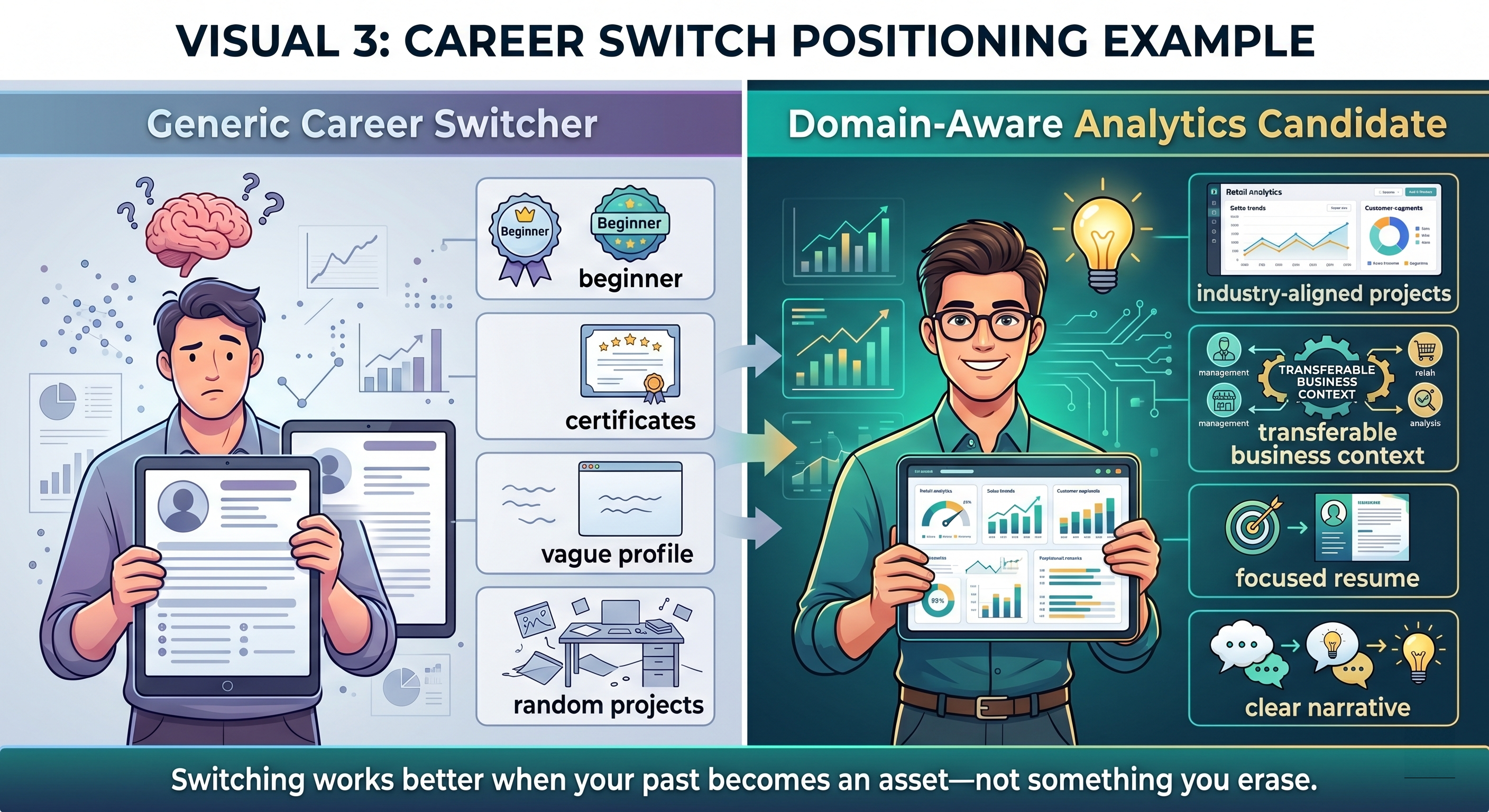
Let’s save people some time. A common but bad strategy looks like this: learn a random SQL tutorial → then a Python tutorial → then a Power BI tutorial → then collect another certificate → then build a generic dashboard project → then mass apply to 300 jobs. This is noise creation, not positioning.
The Better Path
If you want to break into analytics, think like a strategist and follow these steps:
Step 1: Use your existing domain. If you worked in e-commerce, build e-commerce analytics projects. If fintech, build lending or transaction analysis. If healthcare, build healthcare ops analytics. If SaaS, build churn, retention, or funnel analysis. This makes your story believable and makes you look credible.
Step 2: Build proof, not certificates. A strong data analyst portfolio matters far more. Focus on building projects like retention analysis, cohort analysis, funnel analysis, pricing analysis, or operational dashboards.
Step 3: Reframe your resume. Do not present yourself as a blank beginner. Translate your transferable strengths. Instead of 'Career switcher learning analytics', frame it as: 'Operations professional transitioning into analytics with reporting and process optimization experience.' There is a huge difference in how recruiters perceive this.
Step 4: Prepare for communication-heavy interviews. Career switchers often over-focus on technical prep. But interviews test reasoning, clarity, business judgment, and explanation quality—not just SQL syntax.
So… Should You Switch?
The honest answer is: maybe. Not because analytics is inherently 'good', but because fit matters.
Don't switch if:
- You only want a trendy title
- You expect an instant high salary
- You dislike analytical thinking
- You cannot financially absorb the transition risk
Switch if:
- You genuinely enjoy problem-solving
- You can tolerate uncertainty
- You can handle temporary discomfort
- You're willing to build real proof of work
- Your expectations are realistic
Final Thought
People think career switching is about courage. It isn't—it's about clarity. The wrong switch creates stress; the right switch creates leverage. Your age is not the deciding factor. Your strategy is.
Because starting over is scary. But sometimes, you're not actually starting over. You're bringing everything you already know into a smarter direction.
Grit Over Excuses.
— The Grito Team