
Everyone wants to know how to become a data analyst in India.
So they do what the internet tells them to do: Take a course. Finish modules. Collect certificates. Update LinkedIn. Apply to jobs.
Then silence. 50 applications. 100 applications. 250 applications. No callbacks.
And that creates a dangerous assumption: "Maybe I need one more certification."
Probably not.
Because here’s the uncomfortable truth: The analytics hiring market has a certificate oversupply problem. Not because learning is bad, but because signals stop working when everyone has the same signal.
And right now? Everyone has certificates. What companies still struggle to find is something else: Proof that you can actually think like an analyst.
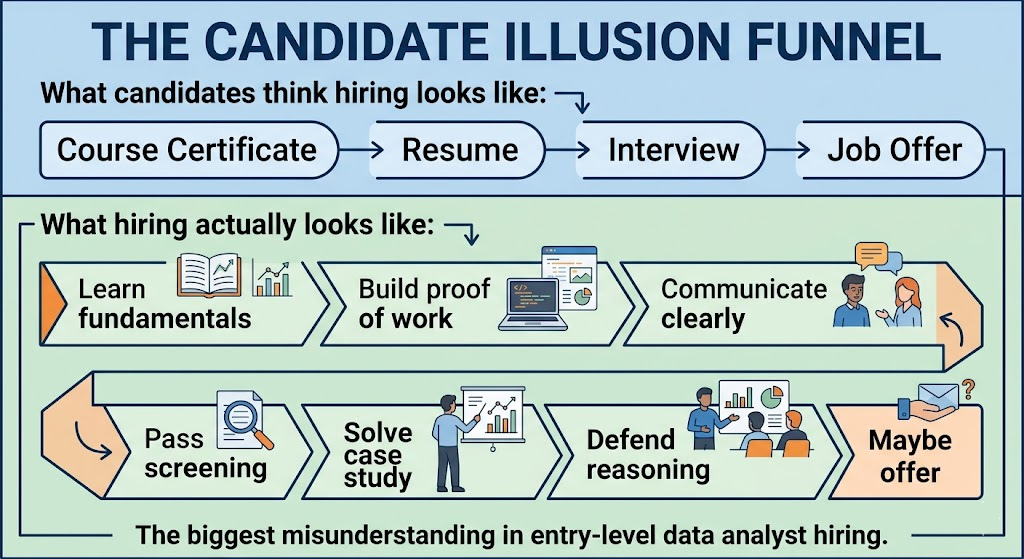
The Certificate Explosion Nobody Talks About
A few years ago, completing a data analytics program actually meant something. Not because the education was exceptional, but because fewer people had done it.
Now? A typical fresher data analyst profile often includes:
- SQL certificate
- Excel certificate
- Power BI certificate
- Python for data analysis certificate
- Dashboard completion badge
- “data analyst roadmap completed” style posts
And so do hundreds of other applicants. This is basic market economics. When everyone owns the same asset, its value drops. Certificates have become that asset.
For entry level data analyst jobs, they’re no longer strong differentiators.
Why Beginners Keep Falling Into This Trap
Because certificates feel productive. Learning analytics is overwhelming. There’s SQL. Then Power BI. Then Excel. Then Python. Then pandas. Then business metrics. Then data cleaning. Then dashboards. Then SQL interview questions. Then data analyst interview prep.
It’s messy. A course makes the chaos feel organized. Module 1. Module 2. Quiz. Badge unlocked. Psychologically, that feels like progress.
And sometimes it is. But employability and progress are not the same thing. That distinction matters.
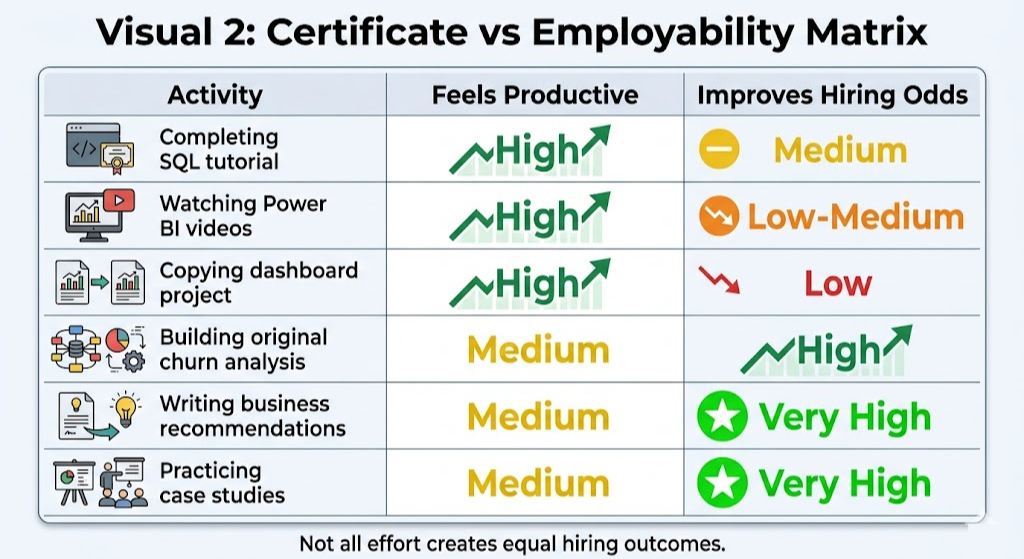
What Recruiters Actually Look For
This is where most assumptions break. Candidates think recruiters deeply inspect certificates. That’s rarely how early filtering works. For data analyst jobs in India, especially fresher roles, initial review is fast.
A recruiter is scanning for pattern recognition, not educational storytelling. They’re unconsciously asking:
1. Does this profile look real? Meaning: clear resume, believable story, coherent progression, skills aligned with role. Not: “Completed 11 certifications.” That often works against you, because excessive certification without proof can feel inflated.
2. Is there evidence this person actually worked with data? This matters far more. Good signals include SQL analysis projects, Excel business cases, Power BI dashboards with commentary, retention analysis, funnel analysis, and customer segmentation work. Weak signals include badges, course screenshots, copied notebooks, and tutorial dashboards. One is proof; the other is decoration.
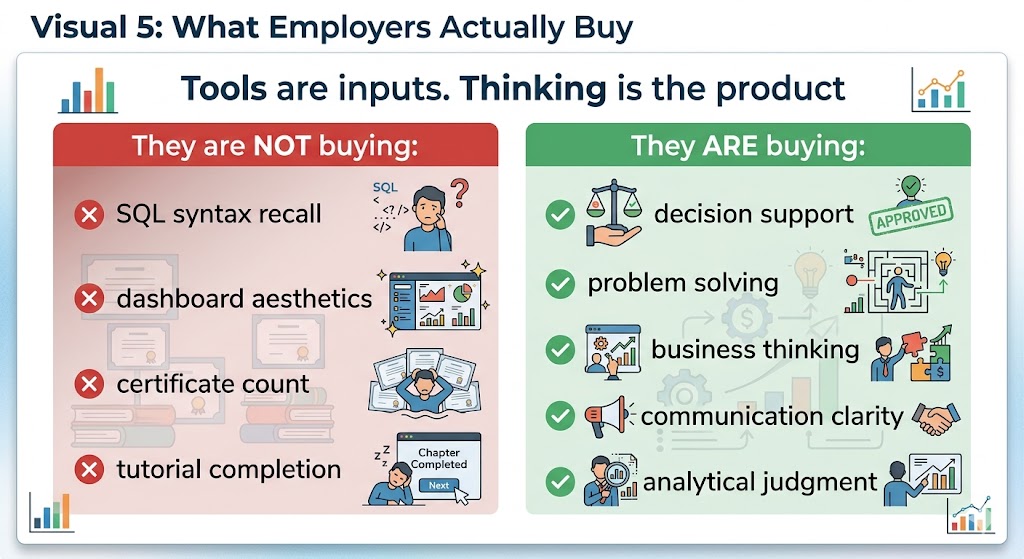
3. Can this person think commercially? This is the big one. A data analyst is not paid to make charts. They’re paid to reduce decision uncertainty.
Weak candidate language: "Built a dashboard showing monthly sales trends."
Strong candidate language: "Analyzed repeat purchase decline and identified second-order retention as the major leakage point."
Same tools. Different thinking.
Portfolio vs Certificate: The Actual Difference
A certificate says: I completed learning material. A portfolio says: I applied learning to a problem. Hiring teams trust the second more because application is harder to fake.
A strong data analyst portfolio demonstrates: SQL problem solving, business reasoning, Power BI communication, Excel structuring, data cleaning logic, and recommendation thinking. That’s employability.
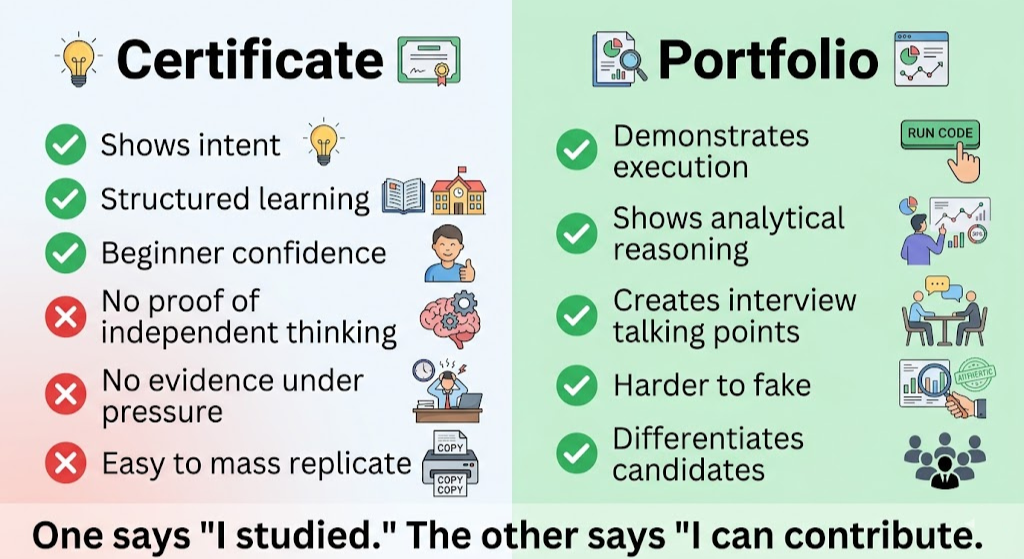
Weak Profile vs Strong Profile
Let’s make this painfully obvious.
Weak Profile: LinkedIn headline: Certified Data Analyst | SQL | Python | Power BI | Excel Resume bullets: - Completed data analytics certification - Learned SQL basics - Built Netflix dashboard - Built sales dashboard - Completed Power BI tutorial Recruiter interpretation: "Looks like everyone else."
Strong Profile: LinkedIn headline: Entry-Level Data Analyst | SQL | Retention Analysis | Power BI Resume bullets: - Used SQL to analyze ecommerce customer retention across 18 months - Built Power BI dashboard comparing acquisition and repeat purchase trends - Created recommendation memo for retention improvement - Cleaned transactional data before analysis Recruiter interpretation: "This person may actually be useful."
That’s the difference.
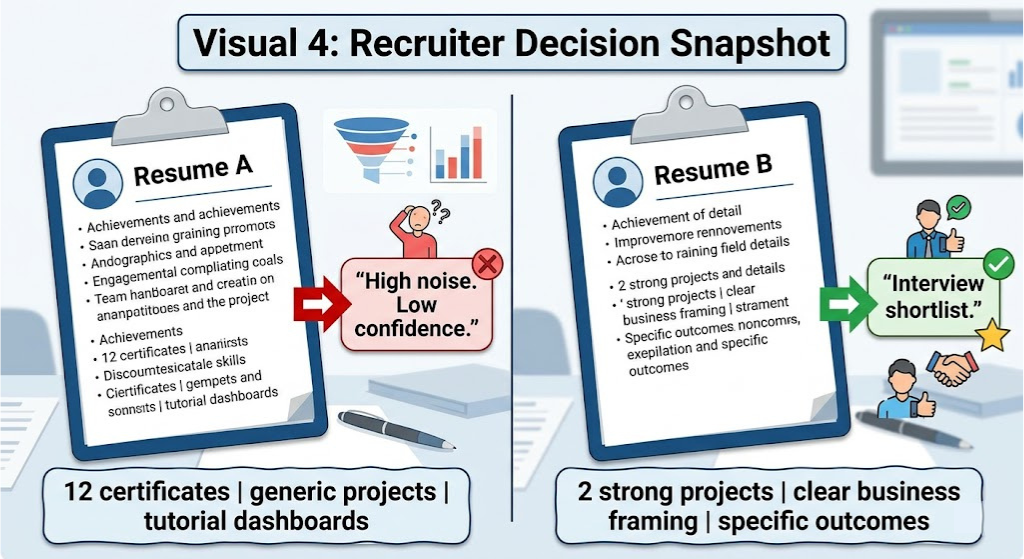
“But I Don’t Have Experience”
Most beginners frame this wrong. They ask: How do I get a data analyst job without experience? A better question is: How do I show analytical thinking without formal employment?
That changes everything. Because experience and evidence are not identical. Proof of work can come from self-driven projects.
Examples of evidence include:
- churn analysis
- cohort analysis
- funnel analysis
- subscription revenue breakdown
- conversion analysis
- marketplace performance review
- product metrics exploration
That is exactly why data analyst projects matter. Not because projects look nice, but because they reduce hiring uncertainty.
The Tutorial Project Problem
This deserves honesty. Too many aspiring analysts build the exact same things. Recruiters repeatedly see: Netflix dashboards, Spotify dashboards, Titanic analysis, generic sales reports, and copied Power BI templates.
The issue is not that these are bad learning tools. The issue is sameness. If your portfolio looks identical to 300 others, it creates no advantage.
Worse: Many candidates cannot explain what they built. That kills credibility immediately.
Why SQL Skills Alone Won’t Save You
Yes, SQL matters. Massively. For most junior data analyst roles, SQL is non-negotiable.
But companies do not hire people to simply write joins. They hire analysts to answer questions like: Why did churn increase? Which funnel step is leaking users? Why did repeat purchases drop? Which acquisition channel underperforms? What changed after pricing shifts?
SQL is just the language. Analysis is the job. Same for Power BI, Excel, Python, pandas, and Tableau. Tools matter. Interpretation matters more.
What Proof of Work Actually Looks Like
Good projects have five traits:
1. Clear Question. Bad: "Analyzed sales data." Good: "Why did repeat purchases fall after month two?"
2. Messy Data Handling. Real analysts clean ugly data. Show duplicates, null logic, assumptions, and transformations.
3. Actual Analysis. Not just charts. Interpretation. Cause hypotheses. Comparisons. Pattern recognition.
4. Recommendation. The analysis should lead somewhere—a business decision, not just observations.
5. Communication. If you cannot explain your thinking clearly, your analysis loses value.
So Should You Ignore Certificates?
No. That would be lazy advice. Certificates can absolutely help, especially if you’re an analytics beginner, switching careers, creating learning structure, building accountability, or learning tools systematically.
But they are support material. Not proof of employability. That distinction matters.
If Your Goal Is Your First Data Analyst Job
Prioritize this order:
Learn: Build fundamentals in SQL, Excel, Power BI, Python for data analysis, and business metrics.
Build: Create original projects such as churn analysis, cohort analysis, funnel analysis, retention dashboards, and conversion breakdowns.
Explain: Document the business question, method, assumptions, findings, and recommendation.
Practice: Prepare for SQL interview questions, case studies, business problem discussions, and data analyst interview prep.
Communicate: Because weak communication quietly eliminates strong technical candidates.
Final Thought
The internet keeps telling people that becoming a data analyst is about collecting enough credentials. That was never fully true. Now it’s even less true.
The market is noisier. Certificates are more common. Signals are weaker. Which means standing out requires stronger evidence. Not louder claims. Not longer LinkedIn certification sections. Not another completion badge. Just better proof.
Completing a course proves attendance. Proof of work proves employability.
Grit Over Excuses.
— The Grito Team